How does a CRO interact with a sponsor? What is project-based delivery, what is FSP, and what hybrid models sit between them? What do the evidence – and real delivery practice – suggest for biometrics teams?
In clinical development, outsourcing discussions are often simplified into a binary choice: FSP or project-based delivery. In practice, the landscape is broader — and the terminology is not always used consistently.
For clarity, in this article FSP (Functional Service Provider) refers to an outsourcing model where specific functions or capabilities are embedded into the sponsor’s operating model, governance, and review pathways. Project-based delivery refers to a more clearly bounded package of work delivered against agreed scope, timelines, and acceptance criteria. Between these two, many real-world setups are hybrid.
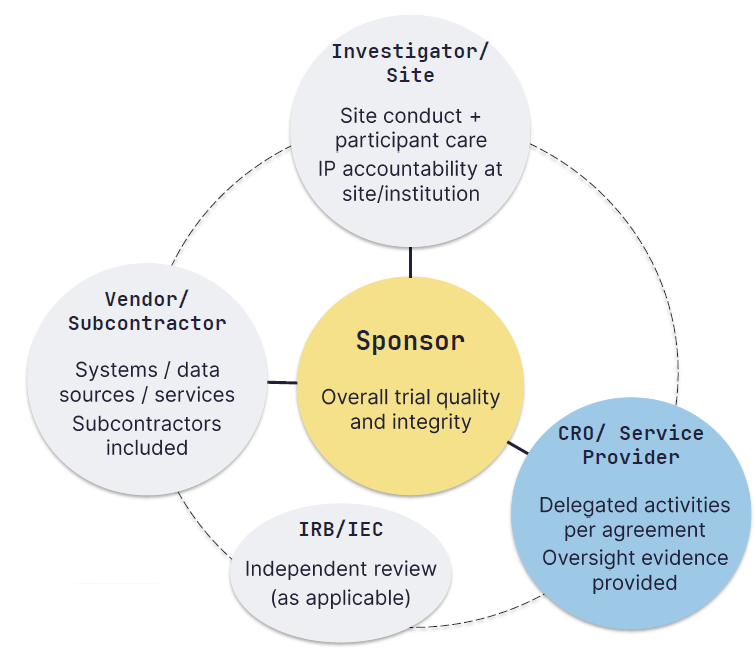
Sponsor and Vendors
There are, of course, other models in the wider outsourcing landscape, including staffing, insourcing, and business process outsourcing. But for biometrics work, the more useful question is usually not which label is “better.”
The more useful question is this: Which operating model creates the least friction, the clearest ownership, and the most reliable delivery for a given study or portfolio?
That question matters especially in biometrics – data management, biostatistics, statistical programming, and the interfaces into medical writing, where quality is rarely lost in theory. More often, it is lost in handoffs, unclear review rights, unstable scope, weak governance, and poor visibility across systems and teams. The literature on clinical outsourcing increasingly suggests that model choice alone does not determine performance; governance and oversight quality matter at least as much. [1][2][3]
The evidence does not support a one-size-fits-all answer.
“A strong FSP model only works when you can truly fit into the client’s way of working – not the other way around. From what I’ve seen, that takes real flexibility. Not just in delivery, but in how teams are set up and how processes actually run day to day. And honestly, that’s often easier to achieve in smaller, more focused companies. At TUNECT, this mindset comes quite naturally. Our founders have hands-on backgrounds across Biostatistics, SAS programming and Data Management – both on the CRO and sponsor side – so the company was built with integration in mind from the start. The goal was never to “impose a model,” but to plug in cleanly and adapt to what the client needs. Another thing I’ve learned is how important it is to stay clear on ownership. What sits with the client, what sits with us – and keeping that transparent. That alignment makes collaboration smoother and builds trust over time.” Anastasia Provorova, Business Development Manager at TUNECT CRO.
The stronger sources on clinical outsourcing point in the same direction: sponsors rarely rely on one model only. In practice, organizations mix internal staff, transactional outsourcing, strategic partnerships, and function-based support depending on portfolio needs, internal maturity, and oversight capacity. [2][3][4]
That is not a weakness of the system. It is a recognition that different work behaves differently.
Key considerations when selecting an FSP partner often include both domain expertise and operating-model fit: experience in the relevant therapeutic area, trial phase, and regulatory context, plus a proven ability to integrate into sponsor processes and deliver similar FSP engagements successfully, on time, and with predictable quality.
Seen this way, model selection is not a theoretical preference but an operating decision. The practical question is not simply whether to choose FSP or project-based delivery, but which model best matches the work itself: its stability, its interfaces, its governance needs, and the degree of sponsor-side control required.
For biometrics, this distinction is especially important. Some work benefits from embedded continuity inside sponsor systems and review cadences; other work is better delivered as a clearly scoped package with defined milestones and acceptance criteria. And increasingly, many teams operate somewhere in between. [4][5][6]
What the literature consistently highlights
Three themes show up repeatedly.
1. Strategic outsourcing only works if oversight works. Earlier work on strategic outsourcing already showed that sponsors were moving away from purely tactical outsourcing toward more integrated relationships, but those relationships did not automatically perform better without alignment, structure, and disciplined oversight. [1][2]
2. Oversight quality is a differentiator, not an administrative afterthought. Studies examining outsourcing oversight practices found clear opportunities to improve executive involvement, performance visibility, and operational governance. In other words, outsourcing success is not determined by the contract model alone. It depends heavily on how sponsorship, review, and oversight are actually run. [3]
3. The market is moving toward more flexible and hybrid configurations. More recent articles on outsourcing model usage and FSO↔FSP transitions suggest that organizations increasingly use hybrid setups to balance continuity, specialized expertise, and variable execution load. This is especially visible where sponsors want governance and decision-making to stay close, but do not want to internalize the full execution workload. [4][5][6]
When FSP tends to work best in biometrics, data management, and medical writing
In this article, FSP is used in the practical sense many sponsors mean: embedded capacity operating within the sponsor’s governance, SOPs, systems, and review pathways. [4][6]
FSP tends to fit best when:
- demand is recurring across multiple studies or a wider program,
- governance, SOPs, and review pathways are already mature,
- decision rights are already clear,
- the sponsor has enough internal bandwidth to prioritize, review, and integrate embedded specialists,
- continuity and internal visibility matter more than a clean end-of-project handoff.
For biometrics and closely linked functions, that often means:
- ongoing SDTM/ADaM production across a program,
- repeated TFL updates and submission cycles,
- continuous data review and query support,
- stable CRF/EDC and data management workflows across studies,
- recurring CSR and medical writing support where consistency of terminology, data interpretation, and document style matters,
- standardized workflows where sponsor-side ownership is strong and stable.
The benefit is not simply “more people.” It is continuity inside an existing operating model.
The risk is also clear: weak governance breaks FSP. If priorities shift constantly, decision rights are fuzzy, and review gates are inconsistent, an embedded team does not become faster. It gets stuck in ambiguity. That pattern is consistent with the broader oversight literature. [2][3]
When project-based delivery tends to work better
Project-based delivery is often the better fit when:
- scope can be clearly bounded,
- outputs and acceptance criteria are explicit,
- delivery can be accepted against milestones and review gates,
- sponsor-side bandwidth is limited,
- change control exists for scope or timeline shifts.
For biometrics and adjacent functions, this often includes:
- a defined ADaM + TFL package for a specific database lock,
- a focused CSR tables/listings package,
- define.xml or metadata package work,
- a discrete data management build or cleanup package,
- a focused medical writing package linked to a specific milestone or deliverable,
- a targeted regulatory-response sprint.
The benefit here is not “less partnership.” It is less operational overhead for a discrete and well-scoped need.
But the red flag is equally clear: unstable scope without change control breaks project delivery.
Why hybrid often works best in real life
In practice, many biometrics teams do not operate at either extreme.
A strong real-world pattern is the hybrid model:
- a small number of embedded leads manage sponsor-side interfaces, priorities, review cadence, and critical decision points,
- while the broader execution engine runs project-based from the CRO side.
This works particularly well when sponsors want:
- visibility and control to stay close,
- but do not want to staff the full execution workload internally,
- and need the ability to scale up and down around key milestones.
For biometrics, that often means:
- embedded leadership around SAP alignment, priorities, issue escalation, and governance,
- with scalable external execution across programming, QC, metadata, data management, or medical writing tasks.
This is not a compromise model. In many settings, it is the best-designed model because it reduces coordination friction without sacrificing visibility. That logic aligns closely with recent industry writing on flexible outsourcing structures and FSO↔FSP transitions. [4][5][6]
“The industry keeps changing and so do collaboration models.
“I remember a time when the FSP model felt kind of weird: the idea of bringing someone from another company into your own processes and systems seemed unusual, even uncomfortable. Then the market changed. It stopped making sense for many companies to keep large internal teams just to cover every function, and FSP became a natural answer. Now we’re in another transition. Clients want flexibility: senior experts involved where they matter most – key milestones, complex decisions, critical deliverables, while routine execution can be delivered project-wise by a CRO. At the same time, many companies outside Big Pharma want something equally important: a partner who treats their study with real care and attention, almost like their own children. That is where boutique CROs like TUNECT have an advantage. We can stay close, flexible, and highly engaged. We believe in open, transparent collaboration, and we genuinely want our clients to have the fullest possible picture of their study. We work under our client’s flag, as if it were not just their project, but ours too.” Olga Ivanova, Director of Business Development
What “good” looks like, regardless of model
The model changes how teams work. It does not change what good looks like.
For biometrics and adjacent delivery functions, the standard is the same in FSP, project-based, and hybrid setups:
- clear scope and interfaces,
- explicit decision rights,
- traceable handoffs,
- reproducible outputs,
- fit-for-purpose QC and data integrity evidence,
- and a defensible chain from SAP → SDTM/ADaM → TFLs/CSR that can be explained in review.
That is where the phrase “partner, not vendor” stops being a slogan.
A real partner does not try to sell one model for every situation. A real partner helps identify where friction will appear:
- in governance,
- in interfaces,
- in scope stability,
- in oversight capacity,
- or in the mismatch between review load and execution load.
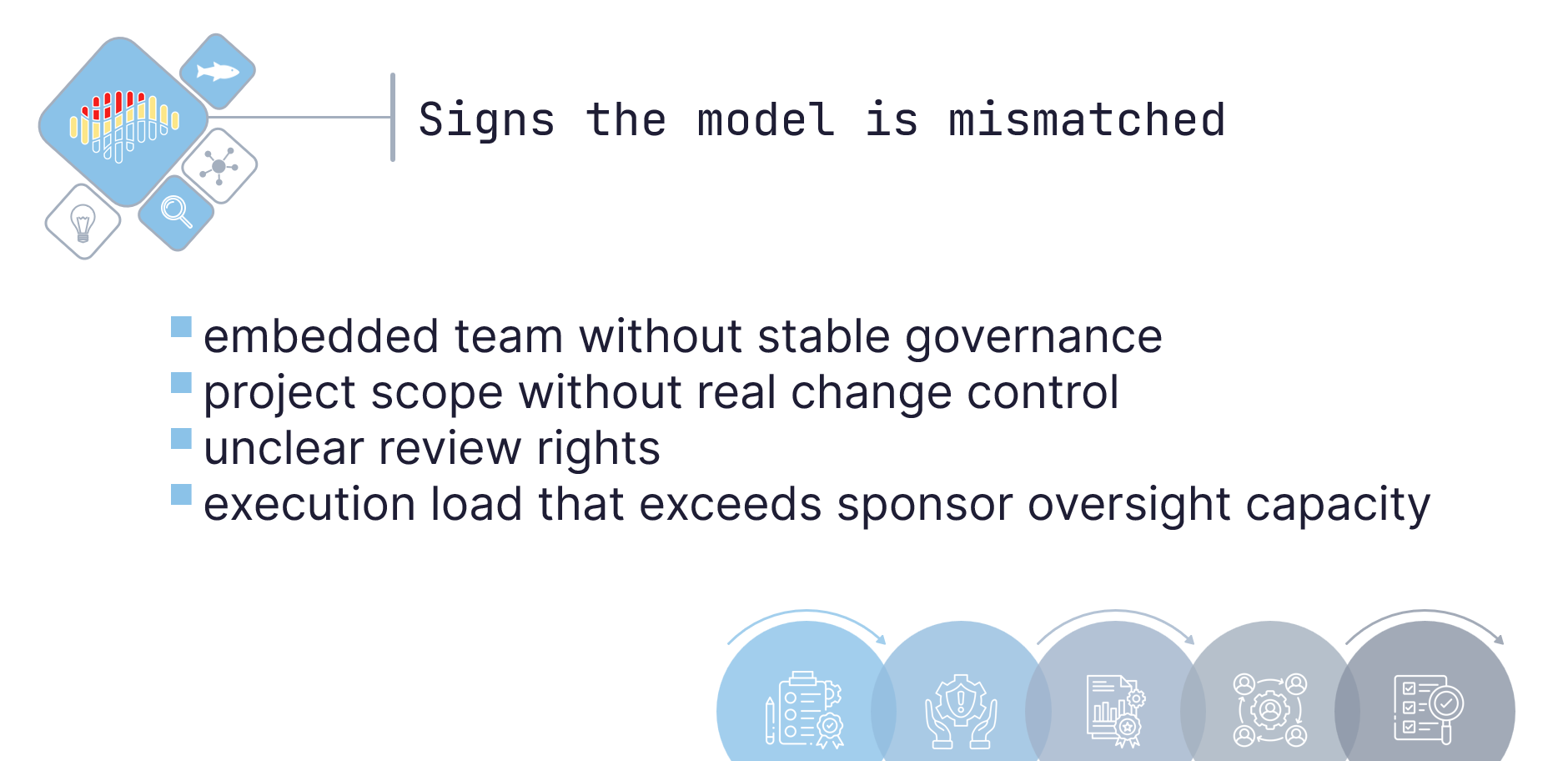
Signs the model is mismatched
FSP has also changed the workforce experience
Over roughly the last decade to decade and a half, FSP models have become much more visible and widely used in clinical development. That shift has influenced not only sponsors and CRO operating models, but also the experience of the people doing the work. Industry sources increasingly connect FSP growth with talent access, workforce flexibility, training, and long-term retention. [1][7][8]
For many professionals, this has changed the experience of building a career. Instead of changing employers every time they want exposure to a new sponsor environment, new systems, or a different operating model, FSP roles can offer something different: continuity of employment combined with broader cross-company experience. In well-designed setups, specialists can work inside different sponsor environments with access to real processes, governance structures, and training ecosystems — often with a level of integration close to that of internal teams. [6][8][9][10]
“One thing I really value in this model is the chance to grow across different sponsor and CRO environments while staying in one stable team. As a SAS programmer, that means I keep learning new standards, workflows, and expectations from different organizations without the disruption of changing companies every time. It’s a strong combination: broader experience, less unnecessary stress, and more focus on doing the work well.” Daniil Maltsev, Senior SAS Programmer
That does not happen automatically. The value depends on integration quality, role clarity, culture fit, training, and sponsor/provider alignment. But when those conditions are in place, FSP can simplify one of the hardest parts of professional growth in this industry: gaining meaningful experience across multiple environments without repeatedly restarting from scratch. [6][8][9][11]
In that sense, the workforce lesson mirrors the delivery lesson: the model works best when it is built around fit, clarity, and well-managed interfaces — not just resource volume. [3][6][8]
The practical decision question
So the right question is usually not:
“Should FSP or project outsourcing be used?”
It is:
“Where are the likely points of friction in this study or portfolio — and which model reduces them without weakening control?”
That is the more useful question for sponsors, CRO leaders, and biometrics teams alike. And it usually leads to better decisions.
References
[1] Jones J. New, Strategic Outsourcing Models to Meet Changing Clinical Development Needs. Perspectives in Clinical Research / The National Institutes of Health.
[2] Getz KA, Lamberti MJ, Kaitin KI. Taking the Pulse of Strategic Outsourcing Relationships. Clinical Therapeutics.
[3] Wilkinson M, DiPietro M, Smith Z, Getz K, Lamberti MJ. Assessing Outsourcing Oversight Practices and Performance. Therapeutic Innovation & Regulatory Science.
[4] Lamberti MJ et al. Outsourcing Model Usage and its Relationship to Clinical Trial Performance. Applied Clinical Trials.
[5] Co-Developing Frameworks for Seamless FSO to FSP Transitions. Applied Clinical Trials.
[6] Crumpler A, Kolchinsky S. The Role of Company Culture in Functional Service Provider (FSP) Partnerships. Journal for Clinical Studies.
[7] The Upward Trend of FSP Outsourcing. Parexel.
[8] The FSP Model in Clinical Research: How Functional Service Providers Support Sponsor Teams. Clinical Leader.
[9] The Art of Recruitment and Talent Development in FSPs. PPD / Thermo Fisher Scientific.
[10] How a Flexible FSP Model Fills the Talent Gap. Clinical Trials Arena.
[11] FSP Partnerships Gain Popularity, Drive Success. PPD / Thermo Fisher Scientific.