Welcome to Part 2 of our series on the “Win Ratio” methodology in clinical trials! Today, we explore the key differences between the Win Ratio and Hazard Ratio, examining their definitions, clinical trial design, endpoints, interpretation, application, focus, and type of data.
Definition
Hazard Ratio (HR): Compares the risk of an event occurring in the treatment group to the control group over time.
Win Ratio (WR): Ratio of treatment success in the experimental group to the control group.
Clinical Trial Design
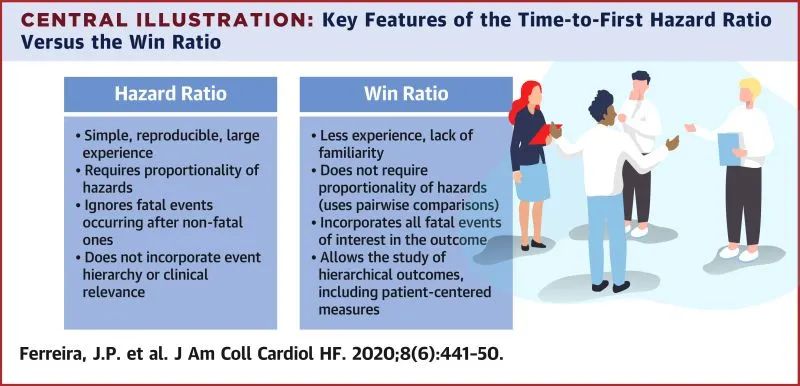
HR: The HR is widely used with a long-standing reputation in clinical trial design, offering simplicity and reproducibility. Both fixed-duration studies and event-driven studies.
WR: The WR application is expanding, driven by its ability to prioritize clinically significant events and incorporate all fatal outcomes. Usually fixed-duration studies.
Endpoint
HR: Focuses on the time to the first event in composite endpoints, often excluding subsequent events.
WR: Considers all events in the composite, including fatal events occurring after non-fatal ones, leading to a more comprehensive assessment of treatment effects.
Interpretation and Application
HR: Greater than 1: Higher risk of event in treatment group. Equal to 1: Equal risk of event in both groups. Less than 1: Lower risk of event in treatment group.
WR: Great than 1: Experimental treatment has higher success rate than control group. Equal to 1: Both groups have the same success rate. Less than 1: Experimental treatment has lower success rate than control group.
Type of Data
HR: Analyzes data based on proportional hazards, requiring certain assumptions to be met.
WR: Does not require proportional hazards and uses pairwise comparisons, making it more suitable for certain scenarios and composite endpoints.
Focus
HR: Primarily considers the time to the first event in the composite outcome.
WR: Takes into account all events in the composite, providing a comprehensive view of the treatment effect.
Study Limitations
Both methods have their limitations, and further research is needed to refine their application in various contexts.
Conclusions and Beyond
The HR and WR offer distinct approaches in analyzing clinical trial data. While the HR enjoys a wealth of experience, the WR is a promising methodology that enables more comprehensive assessments and prioritization of clinically significant outcomes.
References
Part 1 can be founded here: Win Ratio: An Approach to Analyzing Composite Endpoints.
João Pedro Ferreira MD, PhD et al. (2020). Use of the Win Ratio in Cardiovascular Trials. https://lnkd.in/gnRt24Wy