TUNECT INSIGHTS · BIOSTATISTICS & STATISTICAL PROGRAMMING
Is Your Statistical Analysis Plan Really Ready for Programming? A 15-Point Checklist
An approved SAP is not necessarily a programming-ready SAP. Here’s how to identify the gaps before they become ADaM derivation questions, inconsistent TFLs, or last-minute statistical decisions.
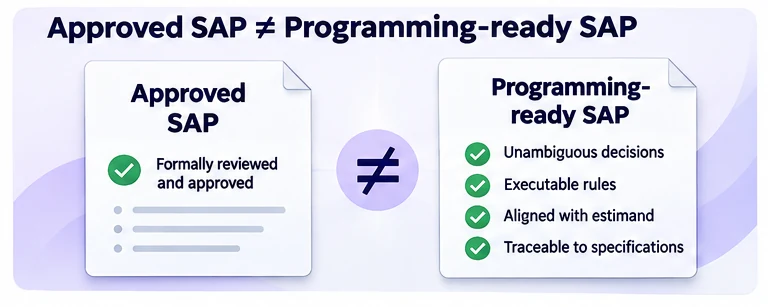
A Statistical Analysis Plan (SAP) can be scientifically sound, formally approved, and still leave statistical programmers with questions that have no unambiguous answer.
Consider three statements that frequently appear in clinical trial analysis plans:
- “Baseline is the last available assessment before treatment.”
- “Patients without documented progression will be censored at the last assessment.”
- “Missing data will be handled using appropriate statistical methods.”
All three sound reasonable. None necessarily provides enough information to implement an analysis consistently.
What happens when two assessments qualify as baseline? When a patient starts another anticancer therapy before the next scheduled tumor assessment? When an MMRM analysis excludes observations after treatment discontinuation, but the estimand requires them?
These are not merely programming details. Depending on the endpoint, they can change which patients contribute to an analysis, which values enter the statistical model, and ultimately which treatment effect is estimated.
Evidence suggests that this distinction deserves attention. A 2020 review of randomized trials published in leading medical journals found that, among 89 trials with publicly available prespecified analysis approaches, 61% had at least one unexplained discrepancy between the planned and reported analyses. The most frequently identified discrepancies concerned the statistical model, analysis population, covariates, and missing-data methods [4].
These findings do not establish that all such plans were unsuitable for programming. They do, however, illustrate why analysis decisions must be sufficiently precise, traceable, and documented.
At TUNECT, we see SAP programming readiness as a distinct quality consideration: the point where scientific intent must be translated into reproducible analysis rules.
An approved SAP and a programming-ready SAP are not the same thing
ICH E9 establishes the importance of prespecifying statistical analyses, while ICH E9(R1) strengthens the link between the clinical question, estimand, analysis, and interpretation [1,2].
The recommendations by Gamble and colleagues also emphasize that a comprehensive SAP should contain sufficient methodological detail to support transparent and reproducible analyses [3].
However, a practical distinction remains:
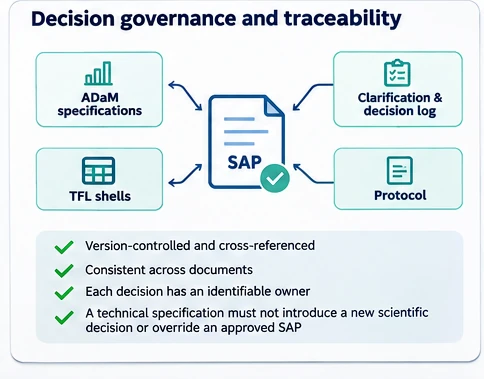
A SAP does not need to contain every technical detail of SAS or R programming. Detailed algorithms may appropriately reside in controlled ADaM specifications, TFL shells, data handling conventions, or other study documentation.
But distributing information across documents creates an additional responsibility: ensuring that the documents remain consistent and that each decision has an identifiable owner.
A practical governance model should establish:
- The SAP: authoritative source for prespecified scientific questions, estimands, populations, analysis methods, and material methodological decisions.
- ADaM specifications: controlled implementation of analysis variables, flags, parameters, and derivations.
- TFL shells: controlled definitions of outputs, analysis populations, statistics, presentation conventions, and footnotes.
- Clarification and decision log: documented resolution of ambiguities, including the decision-maker, rationale, date, affected deliverables, and any impact on the estimand or analysis.
These documents should be version-controlled and cross-referenced. A technical specification must not silently introduce a new scientific decision or override an approved SAP.
Before applying the checklist, reviewers should also confirm that the SAP version, applicable protocol version, approval status, revision history, and timing relative to relevant data reviews and treatment unblinding are documented.
The objective is not to create unnecessary documentation. It is to ensure that every important analysis decision can be traced to an approved source.
THE 15-POINT CHECKLIST
The 15-point SAP programming readiness checklist
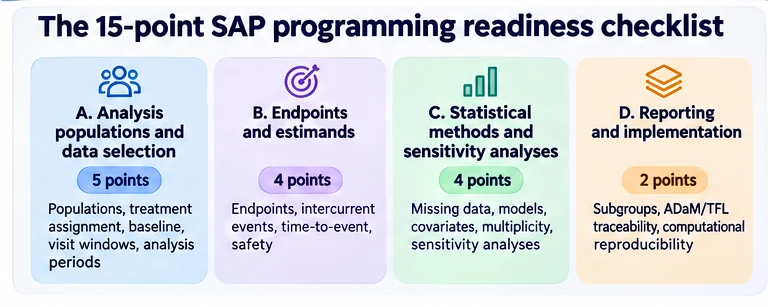
A · ANALYSIS POPULATIONS AND DATA SELECTION
1. Are analysis populations defined with executable inclusion rules?
Terms such as Full Analysis Set, Safety Set, Modified ITT, and Per-Protocol Set are not sufficient by themselves.
The SAP should define the actual criteria for inclusion and any relevant exclusions, including how protocol deviations and incomplete data are handled.
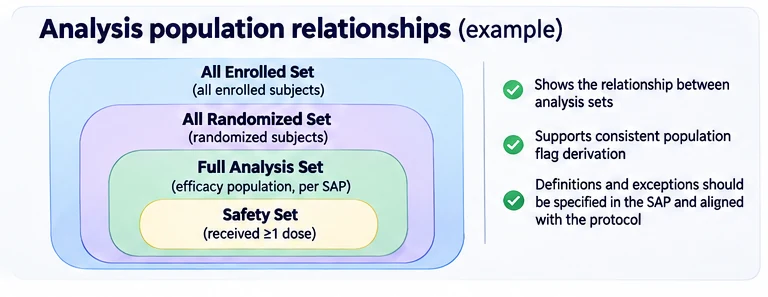
For complex study designs, a visual representation of analysis sets and their relationships can be particularly useful.
Rather than defining every population independently, a practical approach is to start with a clearly defined All Enrolled Set, where appropriate for the study, and describe subsequent analysis sets with explicit reference to their parent populations.
For example:
- All Enrolled Set: All subjects meeting the study’s operational definition of enrollment.
- All Randomized Set: Subjects from the All Enrolled Set who were randomized.
- Full Analysis Set: Subjects from the All Randomized Set who meet the prespecified FAS definition.
- Safety Set: Subjects from the All Enrolled Set who received at least one dose of study treatment, if this is the protocol-defined safety population.
For some studies, these definitions can be shown visually as nested or overlapping populations, making it easier to identify the relationships between analysis sets.
However, populations do not always form a single hierarchy. Depending on the design, a subject might receive study treatment without being randomized. Multiple cohorts, crossover periods, rerandomization, and treatment sequences may require overlapping sets or period-specific populations.
Importantly, All Enrolled Set is a useful organizational convention, not a universally mandated analysis population. Enrollment must also be distinguished from screening and informed consent where the study makes that distinction.
For complex studies, the SAP should ideally be supported by a simple population relationship diagram, showing which sets are subsets of others and where exceptions or overlaps are possible.
2. Is treatment assignment clearly defined for each analysis?
A clinical trial may require different treatment groupings for efficacy and safety.
For example, efficacy analyses may use randomized treatment assignment, while safety summaries use treatment actually received, according to the study-specific definitions.
Treatment misallocation, incomplete dosing, crossover, dose changes, and treatment switching can create additional questions.
The SAP should also distinguish the planned treatment grouping from the operational source used to derive that grouping.
3. Is baseline defined for every relevant endpoint?
“Last available value before treatment” may appear precise, but it leaves several questions unanswered.
A more operational definition might be:
Even this requires further clarification in many studies.
Consider:
- Scheduled versus unscheduled assessments
- Assessments after randomization but before first dose
- Pre-dose measurements collected on the first dosing day
- Multiple observations with the same date
- Date-only versus date-time records
- Missing pre-dose measurements
- Endpoint-specific baseline definitions
For some efficacy endpoints, baseline may instead be tied to randomization or another protocol-defined reference point.
Laboratory, efficacy, PK, and PRO parameters may legitimately use different baseline conventions.
Where relevant, the SAP or controlled specifications should define eligibility and precedence rules rather than allowing programmers to select the most convenient record.
4. Are visit windows and repeated measurements handled explicitly?
Visit windowing is one of the areas where apparently straightforward SAP language can create substantial programming ambiguity.
The protocol’s Schedule of Assessments (SoA) should be the starting point. It defines which assessments are planned and when they are expected to occur, often including permitted visit deviations.
However, a protocol-defined visit allowance is not necessarily the same as an analysis visit window.
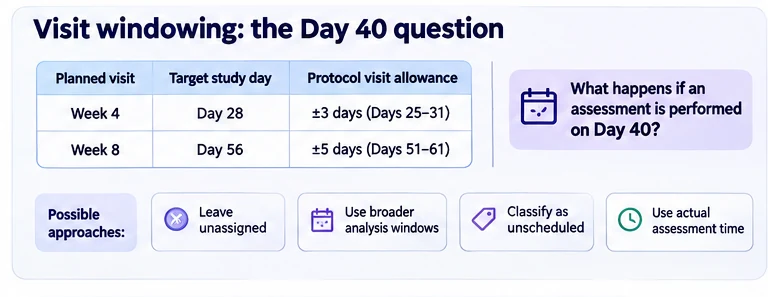
Consider the following hypothetical schedule:
| Planned visit | Target study day | Protocol visit allowance |
|---|---|---|
| Week 4 | Day 28 | ±3 days (Days 25–31) |
| Week 8 | Day 56 | ±5 days (Days 51–61) |
What happens if an assessment is performed on Day 40?
It falls outside both specified protocol visit intervals.
Depending on the endpoint and analysis objectives, several approaches may be reasonable:
- Leave the assessment unassigned to either scheduled analysis visit while retaining it in the dataset.
- Define broader, non-overlapping analysis windows that allow it to contribute to a scheduled analysis visit.
- Classify it as an unscheduled assessment, with rules specifying whether it contributes to a particular analysis.
- Use the actual assessment time in an analysis that does not require nominal visit assignment.
The programming team should not independently choose among these approaches.
Such gaps should be identified during SAP development or review and discussed with the responsible study biostatistician.
The decision may also require input from other functions:
- Clinical Lead / Medical Monitor: Whether an assessment performed between scheduled visits remains clinically comparable to the intended measurement.
- Clinical Operations: How visits were scheduled and conducted, including early termination and unscheduled visits.
- Data Management: How actual visits, dates, and unscheduled assessments are recorded in the EDC system.
- Statistical Programming: Feasibility, record-selection consequences, and consistency of proposed derivations.
- Sponsor Statistician: Alignment with the planned analysis and approval of the methodological decision, where required by governance.
The final analysis-windowing rules should be documented in the SAP or controlled analysis specifications before implementation.
At minimum, the rules should address:
- Target analysis days and window boundaries
- Inclusive or exclusive boundaries
- Gaps and overlapping windows
- Scheduled versus unscheduled assessments
- Multiple assessments within the same window
- Distance from target day and tie-breaking rules
- Early termination and end-of-treatment assessments
- Missing or partial assessment dates
- Endpoint-specific exceptions
- Treatment discontinuation and follow-up assessments
- Whether observations outside analysis windows remain available for other analyses
The goal is not to force every assessment into a nominal visit. It is to define which observations contribute to each planned analysis.
For example, an out-of-window observation may be excluded from a visit-specific MMRM but remain relevant to a descriptive listing, an actual-time analysis, or another endpoint.
This distinction should be planned rather than discovered during output validation.
5. Are analysis periods and data cutoffs unambiguous?
The SAP should identify relevant analysis periods, follow-up boundaries, and data cutoffs.
Particular care is needed for treatment-emergent safety windows, long-term follow-up, interim analyses, and studies with multiple treatment periods.
Relevant operational questions may include:
- Which reference date determines the start and end of each analysis period?
- Are boundaries inclusive?
- How are events spanning two periods classified?
- How are partial or missing dates handled?
- Are time-of-day and time-zone information needed?
- Which observations remain eligible after treatment discontinuation?
Rules for partial dates and period assignment should be documented in the appropriate controlled specifications, with methodological implications resolved by the responsible statistician.
B · ENDPOINTS AND ESTIMANDS
6. Is every endpoint defined as a reproducible variable?
An endpoint name is not a complete algorithm.
For responder endpoints, the SAP should define thresholds, direction of improvement, timing, and confirmation requirements where relevant.
For composite endpoints, it should identify the components and the logical conditions defining an event or response.
For laboratory and biomarker endpoints, additional decisions may involve unit conversions, values below or above quantification limits, and calculation precision.
For PRO endpoints, scoring rules, missing questionnaire items, and interpretation of change may be equally important.
Not every technical rule needs to appear in the SAP itself. However, endpoint-defining choices should be agreed and traceable to controlled documentation.
7. Are intercurrent events aligned with the target estimand?
Treatment discontinuation, rescue medication, treatment switching, and death can affect how treatment effects are defined.
ICH E9(R1) distinguishes strategies such as treatment policy, hypothetical, composite, while-on-treatment, and principal stratum [2].
These strategies answer different clinical questions.
A treatment-policy strategy for treatment discontinuation generally requires consideration of relevant outcome information after discontinuation. A hypothetical strategy may require assumptions about outcomes that would have occurred in the absence of an intercurrent event.
A frequent practical problem is that the SAP may define a statistically reasonable estimand without confirming whether the required information is actually collected.
For example:
- Is treatment discontinuation recorded with a sufficiently precise date?
- Are subsequent therapies and rescue medication documented?
- Are relevant assessments collected after treatment discontinuation?
- Can reasons for missing assessments be distinguished?
- Are deaths and other events available from the appropriate data sources?
These questions should be addressed while data collection procedures can still be improved.
8. Are time-to-event definitions and censoring algorithms complete?
A SAP may specify Kaplan–Meier estimation and Cox regression without fully defining the event and censoring rules.
For progression-free survival, unresolved scenarios may include:
- Progression before or after a new anticancer therapy
- Death without documented progression
- Multiple missed assessments
- Incomplete or inadequate tumor evaluations
- Events after the analysis cutoff
- Different assessment sources or adjudication decisions
The SAP should specify the time origin, event definition, event date, censoring date, and rules for every relevant scenario.
A scenario-based decision table is often more useful than a short narrative statement.
For example, the same patient’s observed history might lead to different derived event or censoring times depending on the prespecified handling of new anticancer therapy and missed assessments.
Those differences can affect event counts, risk sets, estimates, and interpretation.
There is no single censoring algorithm appropriate for every trial. The rules must follow the scientific objective and estimand, rather than being selected because they are convenient to program.
9. Are safety endpoints and analysis windows sufficiently specified?
A general instruction to summarize adverse events may leave major implementation decisions unresolved.
The SAP should define:
- Treatment-emergent event criteria
- Relevant safety observation periods
- Treatment grouping and denominators
- Counting of subjects versus events
- Handling of recurrent events
- Severity, relationship, and seriousness categories
- Events spanning different treatment or follow-up periods
- Exposure-adjusted summaries, where applicable
For example, does a table report the number of subjects with at least one event, total events, or an exposure-adjusted incidence rate?
These quantities answer different questions and require different derivations.
For integrated or pooled safety analyses, additional specification may be needed for study heterogeneity, exposure definitions, pooling rules, and treatment comparability.
Where a formal safety estimand is used, its attributes should be defined consistently with the safety objective. A separate formal estimand is not automatically necessary for every descriptive safety summary.
C · STATISTICAL METHODS AND SENSITIVITY ANALYSES
10. Are missing-data assumptions and methods explicit?
“MMRM will be used” does not completely describe a missing-data strategy.
The SAP should establish which observations contribute to the analysis, the underlying assumptions, and how incomplete data are addressed.
Standard likelihood-based MMRM analyses commonly rely on a missing-at-random (MAR) assumption conditional on the observed information included in the model, together with appropriate model specification.
MMRM does not eliminate the missing-data problem. Whether MAR is plausible depends on the study, its data collection practices, and the reasons observations are unavailable.
It is also essential to distinguish missing observations from data that are not relevant or do not exist under the target estimand.
For example, a treatment-policy estimand addressing treatment discontinuation should generally consider relevant post-discontinuation assessments. Excluding those observations by default may create a mismatch between the estimand and the estimator.
Where multiple imputation is used, the SAP or controlled statistical specifications should provide sufficient detail to reproduce the procedure.
Relevant elements may include:
- Imputation approach and missing-data assumption
- Variables included in the imputation model
- Treatment-group handling
- Baseline and auxiliary variables
- Number of imputations and its rationale
- Random-number seed and relevant software settings
- Rules for combining estimates and variances, including Rubin’s rules where applicable
- Treatment of different data types and missingness patterns
- Delta adjustments or reference-based assumptions for sensitivity analyses, where planned
A random seed helps computational reproducibility but is not sufficient on its own: the algorithm, data ordering, software environment, and model specifications must also be controlled.
11. Are statistical models, covariates, and stratification factors fully specified?
“ANCOVA,” “MMRM,” or “Cox regression” is often not enough.
The SAP should identify the outcome, treatment comparisons, adjustment factors, covariates, stratification variables, interaction terms, and treatment-effect summaries.
For repeated-measures analyses, relevant choices may include:
- Fixed-effects structure
- Visit representation
- Covariance structure
- Estimation method
- Degrees-of-freedom method
- Handling of model convergence problems
For time-to-event analyses, relevant details may include stratification, tie handling, effect estimates, and planned assessment of model assumptions.
Stratification deserves particular attention.
Suppose a study uses region and disease severity as randomization stratification factors.
Which values will be used in the statistical analysis?
- Values recorded by the randomization system at assignment
- Values later entered or corrected in the CRF
- Derived categories based on baseline data
The answer may affect stratified log-rank tests, Cox models, Cochran–Mantel–Haenszel analyses, and other adjusted analyses.
The SAP or supporting specification should identify the authoritative source for each stratification factor and define how discrepancies or missing categories are handled.
If small or empty strata require a prespecified pooling or fallback rule, that rule should be agreed before relevant unblinded analysis.
The same principle applies to model diagnostics and convergence.
Where a violation of assumptions or numerical fitting failure could materially change the primary analysis, a prospective diagnostic and response strategy should be considered. Alternative analyses should not be selected after observing which approach produces the most favorable treatment result.
The SAP must provide sufficient methodological detail to reproduce the model. The programming environment can additionally be controlled through validated code, documented procedures, and reproducible software settings.
12. Is multiplicity control connected to the actual analyses?
Where multiple hypotheses require Type I error control, the testing strategy should be unambiguous.
This includes:
- Testing hierarchy
- Alpha allocation
- Decision rules
- Treatment of analyses not reached within the procedure
- Relevant subgroup or interim-testing considerations
The SAP should distinguish confirmatory analyses from exploratory analyses and identify the intended interpretation of nominal p-values where relevant.
13. Are sensitivity analyses genuinely prespecified and estimand-aligned?
An instruction such as “sensitivity analyses may be conducted if necessary” does not establish a reproducible plan.
Where sensitivity analyses are needed, the SAP should specify their purpose, assumptions, statistical methods, populations, and interpretation.
ICH E9(R1) emphasizes that sensitivity analyses investigate robustness to assumptions while targeting the same estimand [2].
Analyses targeting different estimands may also provide valuable information, but they should be identified appropriately rather than presented as interchangeable sensitivity analyses.
For example, a planned analysis using a hypothetical strategy for treatment discontinuation and another using a treatment-policy strategy may answer different clinical questions.
Simply obtaining similar numerical results would not establish that they are sensitivity analyses of the same estimand.
D · REPORTING AND IMPLEMENTATION
14. Are subgroup analyses and derived classifications prespecified?
Subgroup analyses can create unexpected programming ambiguity when categories, cutoffs, interaction tests, or presentation rules are incomplete.
Questions may include:
- Are subgroups based on baseline or post-baseline information?
- Which source variables define categories?
- Are cutoffs prespecified?
- How are missing values handled?
- Are treatment-by-subgroup interactions planned?
- Are analyses descriptive or intended for formal inference?
Similar problems arise with responder thresholds, clinically meaningful change criteria, and derived biomarker classifications.
15. Can the SAP be mapped to ADaM specifications and TFL shells and reproduced computationally?
This is the final readiness test.
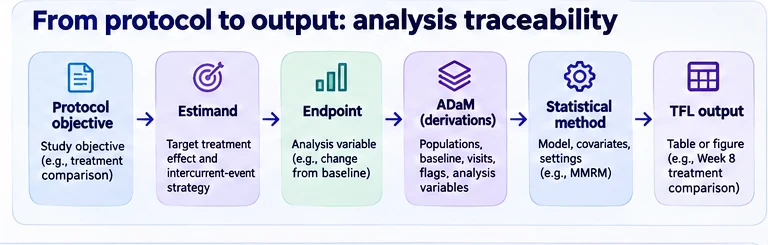
For each major planned analysis, the team should be able to trace:
CDISC ADaM supports reproducibility and traceability among statistical results, analysis datasets, and SDTM source data [5].
A practical mapping should connect the SAP to:
- Subject-level population and treatment variables in ADSL
- Analysis parameters, baselines, visits, and flags in relevant ADaM datasets
- Time-to-event variables and censoring rules in ADTTE, where applicable
- TFL shells with defined populations, timepoints, statistics, and footnotes
- Controlled derivations and validation expectations
A simple analysis traceability matrix can make this relationship visible.
For example, consider a synthetic longitudinal efficacy analysis:
| Element | Illustrative specification |
|---|---|
| Objective | Compare treatments on fatigue symptoms through Week 8 |
| Estimand | Treatment difference in mean fatigue-score change at Week 8, with a prespecified strategy for treatment discontinuation |
| Endpoint | Change from baseline in fatigue score at Week 8 |
| Population | Protocol-defined Full Analysis Set |
| Derivation | Baseline, change from baseline, analysis visit, and record-selection rules in ADaM specifications |
| Method | Prespecified MMRM, including covariates, covariance structure, and inference settings |
| Output | Week 8 treatment comparison in the defined TFL shell |
The matrix should identify the relevant controlled document or specification for each rule.
Computational reproducibility requires additional attention.
Depending on the analysis and deliverable, this may include:
- Statistical software and relevant package/procedure versions
- Model-fitting options and numerical settings
- Random-number seeds for stochastic procedures
- Precision and rounding conventions
- Unit conversions
- Partial-date conventions
- Duplicate-record handling
- Values below or above assay quantification limits
- Version-controlled programs
- Appropriate independent QC or validation
These details do not all belong in the SAP. Their appropriate location depends on the study’s documentation framework.
What matters is that they are specified, controlled, and consistent with the approved analysis decisions.
Five examples: where apparently clear SAP wording breaks down
The following are synthetic examples illustrating common classes of ambiguity. They do not describe identifiable TUNECT client projects.
| Ambiguous SAP wording | Programming question | Decision required |
|---|---|---|
| “The Full Analysis Set will include all randomized patients with available efficacy data.” | Does a randomized subject without a post-baseline assessment belong to the FAS? What does available efficacy data mean? | Define the inclusion algorithm, parent population, and handling of missing endpoint data; confirm consistency with the protocol and estimand. |
| “Baseline is the last non-missing assessment before treatment.” | Do unscheduled assessments qualify? What if two assessments share a date or one occurs after randomization? | Specify eligibility, timing cutoff, date-time precedence, and tie-breaking rules for each parameter. |
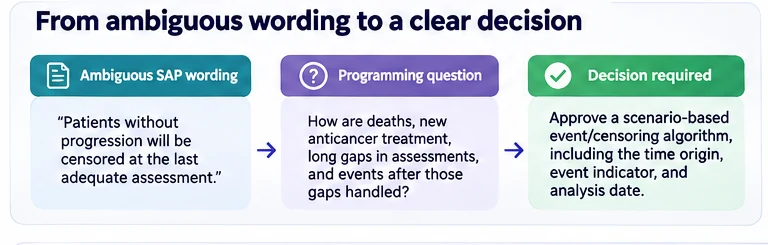
| “Patients without progression will be censored at the last adequate assessment.” | How are deaths, new anticancer treatment, long gaps in assessments, and events after those gaps handled? | Approve a scenario-based event/censoring algorithm, including the time origin, event indicator, and analysis date. |
| “Missing data will be handled using MMRM, with multiple imputation as needed.” | Which post-discontinuation observations are included? What is the imputation model, number of imputations, seed, and combining rule? | Define the model, missing-data assumptions, MI procedure, and relationship to the estimand. |
| “Sensitivity analyses will assess the robustness of the primary results.” | Which assumptions will change? Which analyses are planned? Are they estimating the same treatment effect? | Prespecify sensitivity scenarios, statistical methods, estimand alignment, and intended outputs. |
These examples reveal a common pattern.
The wording may be scientifically plausible, but it still leaves multiple possible implementations.
And when more than one implementation is reasonable, the correct response is not to let the programmer choose silently.
The decision should be escalated to the responsible statistician, resolved with appropriate scientific and clinical input, and documented in the controlled study records.
From a checklist to a practical readiness assessment
A checklist becomes more useful when each potential gap is connected to a decision, an owner, and a resolution status.
Instead of recording only “Yes” or “No,” we recommend a simple review worksheet.
| Field | Purpose |
|---|---|
| Checklist item | Which aspect of the analysis is being reviewed? |
| Readiness status | Ready / Clarification required / Blocked |
| Issue or ambiguity | What cannot currently be implemented unambiguously? |
| Decision owner | Who is responsible for resolving the scientific or operational question? |
| Controlled source | Where will the agreed decision be documented? |
| Impact | Which estimand, derivation, analysis, or output could be affected? |
| Priority and due date | When must the issue be resolved to protect the analysis timeline? |
Not every issue requires an SAP amendment.
For example, an unambiguous SAP rule may simply require additional technical detail in the ADaM specifications.
By contrast, an unresolved censoring strategy or a change in the population targeted by the primary analysis may require a formal methodological decision and corresponding controlled-document update.
A practical severity classification can help prioritize the review:
- Blocker: A missing or conflicting decision prevents valid implementation of an important analysis.
- Major: Ambiguity could materially affect results, traceability, or interpretation.
- Minor: Clarification is needed, but the scientific analysis is already defined and the remaining issue is primarily technical or presentational.
The classification should be based on potential impact, not merely on the number of documents affected.
Why these ambiguities matter beyond programming
Incomplete specifications create more than additional questions during development.
They can lead to several downstream problems.
Inconsistent ADaM derivations. Two programmers may select different baseline records or assign different population flags while believing they followed the same SAP.
Late statistical decisions. Model settings, missing-data strategies, stratification conventions, or censoring rules may only be finalized after programming is underway.
Rework across TFLs and CSR. A change to one definition can propagate through analysis datasets, tables, figures, listings, and clinical interpretation.
Unclear QC expectations. Independent validation becomes less meaningful when the expected result is not unambiguously defined.
Reduced interpretability. A technically correct statistical output may answer a different question from the one intended in the protocol.
Weak change traceability. If an analysis rule changes without a documented rationale, it can become difficult to distinguish implementation clarification from a change in scientific intent.
The issue is therefore not whether programmers are capable of resolving ambiguity. Experienced statistical programmers often identify these problems precisely because they understand the analysis.
The issue is whether scientific decisions are made by the appropriate people, at the appropriate time, with adequate documentation.
What should an independent SAP review actually assess?
A conventional SAP review may focus on statistical appropriateness, consistency with the protocol, and regulatory expectations.
A programming-readiness review adds another perspective:
At TUNECT, we recommend combining statistical and programming perspectives when reviewing SAP readiness.
A practical independent review should examine four dimensions:
| Review dimension | What to evaluate |
|---|---|
| Scientific consistency | Alignment of objectives, estimands, endpoints, populations, and analysis methods |
| Programming readiness | Derivation clarity, completeness of decision rules, handling of edge cases, and output specifications |
| Data feasibility | Availability and timing of required source data, including intercurrent events and post-discontinuation assessments |
| Governance and traceability | Consistency, version control, decision ownership, and traceability across protocol, SAP, specifications, shells, and reporting |
The outcome should not simply be a document with tracked changes.
A more useful deliverable is a prioritized issue and decision log that identifies what needs clarification, who must make the decision, which documents are affected, and whether the issue has been resolved.
For high-impact endpoints, a short statistical-programming walkthrough can be especially valuable: attempt to translate a planned analysis into dataset variables, algorithms, model specifications, and a final TFL shell before production programming begins.
If the team cannot do that without making new methodological decisions, the analysis is not fully specified.
When should this review happen?
Programming readiness is not a one-time document characteristic. It should be considered at relevant milestones throughout study planning and delivery.
During protocol and CRF development
Review whether the planned data collection can support the intended estimands, endpoint derivations, and analysis methods.
During SAP development
Resolve methodological ambiguity before final approval, especially for important efficacy and safety analyses.
Before finalizing ADaM specifications and TFL shells
Confirm that the scientific decisions translate consistently into analysis variables and outputs.
Before planned unblinded analysis and database lock, as applicable
Confirm that critical analysis decisions are appropriately finalized under the study’s blinding, review, and approval procedures.
Following material protocol or SAP amendments
Assess whether population definitions, endpoint rules, model specifications, or reporting outputs require updates.
A programming-readiness review does not replace the established document approval process.
Material changes to planned analyses must follow the appropriate governance and change-control procedures. Deviations from prespecified analyses and important post hoc analyses should be transparently documented and reported, consistent with applicable reporting guidance [3,6].
The objective is to resolve uncertainty prospectively, not retrospectively justify analysis decisions after results are known.
Final takeaway: a SAP is ready when its decisions are executable
A good SAP does more than name appropriate statistical methods.
It connects the clinical objective to the population, endpoint, estimand, analysis assumptions, and reporting strategy.
A programming-ready SAP goes one step further: it allows the analysis to be implemented consistently, with methodological decisions already resolved and appropriately documented.
The practical test is simple:
If the answer depends on undocumented assumptions, the SAP may be approved, but it is not yet fully ready for programming.
Request an Independent SAP Review
TUNECT supports sponsors and CROs with biostatistical review, SAP development, statistical programming, CDISC ADaM implementation, and TFL production.
An independent SAP review can help identify missing analysis rules, inconsistencies, and programming ambiguities before they lead to rework or affect the interpretation of clinical trial results.
Request an Independent SAP Review – contact TUNECT at info@tune-ct.com to discuss your protocol, SAP, and planned analysis deliverables.
References
- International Council for Harmonisation (ICH). E9: Statistical Principles for Clinical Trials. 1998. EMA guideline.
- International Council for Harmonisation (ICH). E9(R1): Addendum on Estimands and Sensitivity Analysis in Clinical Trials. 2019. EMA guideline and adopted addendum.
- Gamble C, Krishan A, Stocken D, et al. Guidelines for the Content of Statistical Analysis Plans in Clinical Trials. JAMA. 2017;318(23):2337–2343. https://doi.org/10.1001/jama.2017.18556.
- Evidence of unexplained discrepancies between planned and conducted statistical analyses: a review of randomised trials. BMC Medicine. 2020;18:137. https://doi.org/10.1186/s12916-020-01590-1.
- Clinical Data Interchange Standards Consortium (CDISC). Analysis Data Model (ADaM): Standards and Implementation Resources. Official CDISC documentation.
- CONSORT 2025 Explanation and Elaboration: Updated Guideline for Reporting Randomised Trials. BMJ. 2025. https://doi.org/10.1136/bmj-2024-081124.
- European Medicines Agency. Guideline on Missing Data in Confirmatory Clinical Trials. EMA/CPMP/EWP/1776/99 Rev. 1. EMA guidance.
The 15-point checklist, readiness classifications, and synthetic examples are TUNECT’s practical review framework, informed by the referenced statistical principles, published research, reporting guidance, and data standards. They are not presented as a separately mandated regulatory checklist.