What is Hardcoding?
The public domain lacks a clear operating definition of hardcoding. Let’s review several definitions:
- Hardcoding: Inserting or correcting data directly into a program’s source code, bypassing external sources, when data is missing or needs correction [1].
- Hardcoding: Programmatic data changes in a database without an audit trail, resulting from incorrect data entry from a Case Report Form or other data collection medium [2].
- Hardcoding: Manually embedding specific information into a program, overriding data from the clinical data management system or other sources [3].
Reasons why hardcoding is a bad practice [1, 2, 3]:
- Data Integrity and Audit Trail Compromise: Hardcoding overrides clinical data management system controls, risking data discrepancies and impeding audit traceability, compromising data integrity.
- Regulatory Compliance Risk: Federal regulations, like 21 CFR 11, stress accurate electronic recordkeeping. Hardcoding may breach these regulations, leading to potential regulatory actions and consequences.
- Validity Concerns: Hardcoding may become invalid over time, hindering updates and causing database inaccuracies.
- Accountability Impact: Hardcoding diminishes accountability, raising doubts about data entry responsibility and integrity.
- Ineffective Data Monitoring: Hardcoding complicates data audit and interpretation, impacting data monitoring and clinical trial data reliability.
Best Practices for Transparent CT
Ensure Proper Approval: Standardize approval for hardcoding instances. Document justifications and involve responsible individuals for accountability.
Document the Agreement: Utilize a specific hardcoding agreement form to record all details of the approval process, which will serve as a crucial reference point for auditors and QA teams, ensuring transparency.
Use Standard Comments and Logs: Enhance transparency in your code by incorporating standard comments and PUT statements in the log when applying hardcoding.
Explore Alternatives: Prioritize traceable approaches, avoiding permanent hardcoding when possible.
Collaborate for Quality: Foster open discussions within the team to address hardcoding challenges and ensure data integrity.
Maintain trustworthiness and compliance in clinical trial data through these practices.
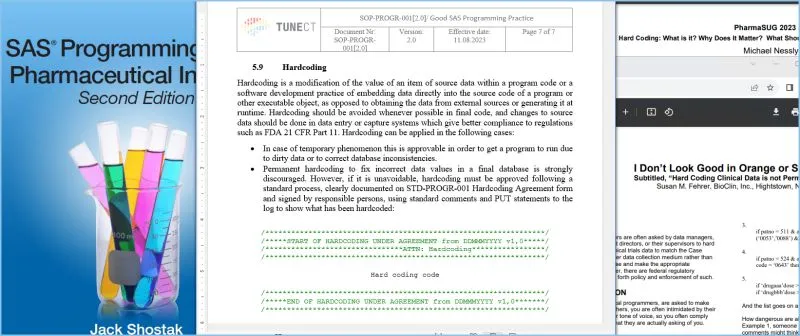
- Michael Nessly, PharmaSUG 2023 (https://lnkd.in/efCpiAYm)
- Susan F., PharmaSUG 2000 (https://lnkd.in/ej8-UgRP)
- Jack Shostak, SAS Programming in the Pharmaceutical Industry (https://lnkd.in/eMApjBcX)